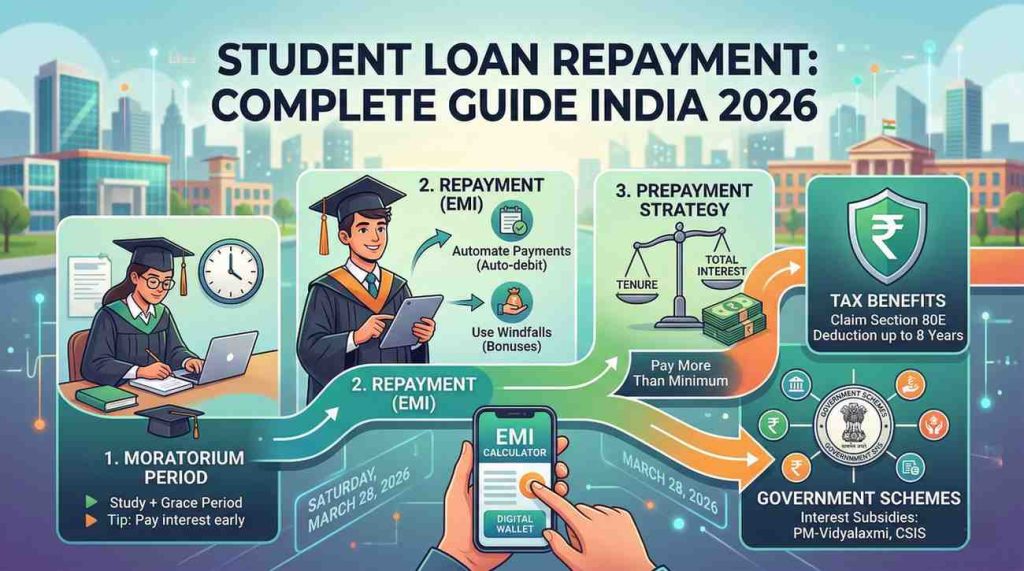
Key Takeaways for Smarter Student Loan Repayment
Before you close this article, lock in these core principles that I consider non-negotiable for any education loan borrower in India:
- Service the moratorium interest as it accrues, even partially. This prevents principal inflation and reduces your total burden significantly.
- Choose your repayment tenure wisely. The goal is the shortest tenure your monthly budget can sustain, not the longest that your bank approves.
- Claim Section 80E without fail. Collect your interest certificate from your bank every March and submit it with your ITR. This is free money in the form of tax savings.
- Make at least one prepayment in the first three years. Your annual bonus, tax refund, or any windfall income directed to prepayment in this window has the maximum impact on total interest saved.
- Check your loan statement quarterly. Know your exact outstanding principal, the current interest rate, and the remaining tenure at all times.
- Explore refinancing if your CIBIL score has improved and interest rates in the market have dropped since you took the original loan.
Introduction
You spent years preparing for your dream university. You took the loan, finished the degree, and landed a job. Now comes the part nobody talks about enough: student loan repayment. And if you are not prepared, it can quietly drain your salary for a decade.
I have tracked how hundreds of Indian graduates manage their education loan repayment, and the pattern is almost always the same. Students who plan their repayment strategy before they sign their first offer letter pay significantly less interest and close their loans years ahead of schedule. Those who figure it out as they go end up paying the bank far more than they ever needed to.
This guide covers everything about student loan repayment in India, from understanding your moratorium period to choosing the right EMI structure, claiming your Section 80E tax benefit, and making prepayments that genuinely accelerate your loan closure. If you have an education loan outstanding or are about to take one, this is the one article you need to read completely.
Quick Facts Table
| Parameter | Details |
|---|---|
| Repayment Tenure | 10 to 15 years (post moratorium) |
| Moratorium Period | Course duration + 6 to 12 months |
| Tax Benefit | Section 80E — full interest deduction for 8 years |
| Prepayment Penalty | Usually nil after 12 months (varies by lender) |
| EMI Start | After moratorium ends |
| Interest Accrual | Begins from first disbursement date |
| Typical Loan Range | ₹4 lakh to ₹1.5 crore |
| Top Repayment Modes | NACH auto-debit, online portal, bank branch |
| Government Scheme | Central Sector Interest Subsidy Scheme (CSIS) |
| Best Strategy | Part-prepayment in first 3 years |
What Student Loan Repayment Actually Means in India
When most borrowers think about student loan repayment, they picture a single monthly EMI deducted from their salary. The reality is more layered than that, and understanding the full structure is what separates smart borrowers from those who overpay.
Your repayment journey has two distinct phases. The first is the moratorium period, which runs through your entire course duration plus an additional 6 to 12 months after you graduate. During this window, your EMI has not started yet, but in most cases, simple interest is already accruing on the disbursed amount from day one. If you do not service this interest during the moratorium, it capitalises into your principal at the end of the period, which means your actual repayment burden is higher than the original loan amount.
The second phase is the active repayment period, typically 10 to 15 years, during which you pay structured EMIs covering both principal and interest. The longer you stretch this tenure, the lower your monthly EMI, but the total interest paid over the life of the loan increases considerably.
The number most borrowers miss: On a ₹40 lakh loan at 11% interest over 12 years, the total interest outgo can exceed ₹35 lakh. That is nearly as much as the principal itself. This is precisely why prepayment strategy matters from month one of your employment.
The Moratorium Period: What Happens Before Your EMI Begins
The moratorium period is one of the most misunderstood aspects of education loan repayment in India. Most students assume that “no EMI during course” means “no financial obligation during course.” That assumption is costly.
How Interest Accrues During Moratorium
From the day your bank disburses the first tranche of your loan, interest starts building. Public sector banks typically charge simple interest during the moratorium. If you do not pay this interest as it accumulates, it gets added to your principal once the moratorium ends. Your EMI then gets calculated on this inflated balance.
For example, on a ₹30 lakh loan at 9.5% interest, the simple interest accruing over a two-year course plus a six-month job search period is approximately ₹7.1 lakh. If you do not service this amount during the moratorium, your effective loan balance at EMI start date is ₹37.1 lakh, not ₹30 lakh.
The Smart Approach During Moratorium
If your family can manage it financially, I always recommend servicing the simple interest during the moratorium period. This single habit can reduce your total repayment burden by 15 to 20 percent. Even partial interest payments help. You do not need to pay the full interest every month, but paying whatever is possible prevents the capitalisation spiral.
► MY POV: From my research into real loan cases, students who paid even 50 percent of the accruing interest during their study period ended up repaying their loans 2 to 3 years ahead of peers who paid nothing during moratorium. The effort required is small; the financial impact is large. I consider this the single highest-value action a borrowing student can take.
EMI Structures and Repayment Options Available in India
Once the moratorium ends, your lender will set up your repayment schedule. Understanding the different repayment options available gives you real control over your financial health.
Fixed EMI Repayment
This is the standard structure offered by most public sector banks. Your EMI amount stays constant throughout the loan tenure. It is predictable and easy to budget for, but it does not account for the fact that your income will likely grow significantly over 10 to 15 years.
Step-Up EMI (Graduated Repayment)
Several NBFCs and private banks now offer a step-up repayment model where your EMI starts lower in the first year and increases progressively, usually annually, in line with expected salary growth. This structure suits fresh graduates who are still building their career income.
Flexible Repayment with Lump Sum Options
Some lenders allow you to pay a lower regular EMI with the option to make lump sum payments at any point during the year without penalty. This works particularly well for professionals who receive annual bonuses or performance incentives.
Repayment Comparison Table
| Repayment Type | EMI Structure | Best For | Interest Impact |
|---|---|---|---|
| Fixed EMI | Constant throughout tenure | Stable salaried professionals | Standard |
| Step-Up EMI | Starts low, increases yearly | Fresh graduates | Slightly higher total |
| Flexible + Lump Sum | Variable, with prepayments | Bonus earners, freelancers | Lower if used well |
| Accelerated Repayment | Higher EMI, shorter tenure | High earners | Lowest total interest |
Section 80E Tax Benefit: The Repayment Advantage Most Borrowers Ignore
If there is one aspect of student loan repayment that Indian borrowers consistently underutilise, it is the Section 80E tax deduction. I find this particularly frustrating because it is one of the most generous tax benefits in the Indian tax code, and it requires zero special action beyond taking an education loan.
What Section 80E Covers
Under Section 80E of the Income Tax Act, 1961, the entire interest component of your education loan EMI is deductible from your taxable income. There is no upper limit on the deduction amount, unlike most other tax benefits. This deduction is available for a maximum of 8 consecutive assessment years starting from the year you begin repayment.
How Much Can You Actually Save?
On a ₹50 lakh loan at 10.5% over 12 years, your annual interest payment in the first year is approximately ₹5.2 lakh. If you fall in the 30% tax bracket, that deduction alone saves you around ₹1.56 lakh in taxes in year one. Over 8 years of repayment, the cumulative tax saving from Section 80E on a large loan can cross ₹8 to 10 lakh.
Who Can Claim It?
The borrower (the student, once employed and filing returns independently) can claim this deduction. If the loan is in the parent’s name as co-borrower, the parent can also claim it during repayment. Always collect your bank’s interest certificate at the end of each financial year to submit with your ITR.
The critical point: This deduction is available only under the old tax regime. If you have opted for the new tax regime under Section 115BAC, Section 80E does not apply. Factor this into your tax planning from the first year of repayment.
Prepayment Strategy: How to Close Your Student Loan Years Early
The most powerful tool in your student loan repayment arsenal is prepayment, and most Indian borrowers either ignore it or discover it too late. I want to change that.
Why Prepayment Works So Well for Education Loans
Education loans in India are structured on a reducing balance method. Every rupee you prepay reduces the outstanding principal, which in turn reduces the interest calculated for subsequent months. The earlier in the loan tenure you make a prepayment, the higher its impact on total interest saved.
What Others Miss About Prepayment Timing
Most financial guides tell you to prepay “whenever you have extra money.” That is not wrong, but it is incomplete. The first three years of your loan tenure are the highest-impact prepayment window. This is when the interest-to-principal ratio in your EMI is at its steepest. A ₹2 lakh prepayment in year two of a 12-year loan saves significantly more total interest than the same ₹2 lakh prepayment in year eight.
Practical Prepayment Sources
- Annual performance bonus from your employer
- Tax refund from ITR filing
- Festival bonuses or incentive payouts
- Windfall income from freelance projects
- Part of a salary increment allocated intentionally to loan closure
Most public sector banks and NBFCs allow prepayment without any penalty after the first 12 months of repayment. Always verify this clause in your loan agreement before making a lump sum payment.
Student Loan Repayment Rules
India does not follow one universal student loan repayment rule. The Reserve Bank of India and the Indian Banks’ Association have established baseline guidelines that all scheduled banks must follow, and knowing them protects you from lender misinformation.
The core rules every borrower must know:
- Repayment begins after moratorium ends — covering your full course duration plus 6 to 12 months. No lender can demand EMI payments while you are actively studying.
- Minimum repayment tenure is 5 years, extendable up to 15 years depending on the loan amount and lender policy.
- Prepayment is your right — public sector banks cannot charge a prepayment penalty on floating-rate education loans, per RBI guidelines.
- No upper cap on loan tenure extension exists for genuine hardship cases; restructuring is available on request.
The rule most borrowers overlook: interest accrues from your first disbursement date, not from your EMI start date. That gap is entirely your financial responsibility, and ignoring it inflates your principal before repayment even begins.
Read More: Education Loan Eligibility Criteria in India: Everything You Need to Know
Common Mistakes Indian Borrowers Make During Loan Repayment
Even well-intentioned borrowers make avoidable errors during the repayment phase. Knowing these mistakes in advance costs you nothing. Discovering them firsthand costs you lakhs.
Mistake 1: Not Tracking the Moratorium Interest
The most expensive mistake. Borrowers assume that because no EMI is due, no money is moving. The interest meter is running from day one of disbursement. Check your loan account statement every three months during your study period.
Mistake 2: Choosing the Longest Tenure for the Lowest EMI
A 15-year tenure on a ₹50 lakh loan at 11% produces a lower monthly EMI than a 10-year tenure, but the total interest outgo increases by ₹18 to 22 lakh. Take the shortest tenure your budget can handle comfortably, not the one that feels easiest today.
Mistake 3: Missing the Section 80E Window
This deduction is available for only 8 consecutive years from the start of repayment, not 8 years of your choosing. Students who delay starting repayment or restructure their loans sometimes accidentally lose their full 8-year deduction window. Start the clock carefully.
Mistake 4: Not Informing the Bank About a Change in Address or Account
Auto-debit failures due to outdated account information or address mismatches can trigger loan default notifications. Even a single missed EMI affects your CIBIL score significantly. Keep your bank updated on every change.
Mistake 5: Ignoring Refinancing Options
If you took your education loan at 12.5% three years ago and your credit profile has improved substantially, you may now qualify for a balance transfer to a new lender at 9.5 or 10 percent. A 2 to 3 percentage point rate reduction on a large outstanding balance can save 6 to 10 lakh in total interest.
Conclusion: Take Control of Your Student Loan Repayment Starting Now
Student loan repayment in India does not have to be a decade of financial stress. It can be a structured, manageable process that you complete ahead of schedule if you approach it with the right knowledge from the start.
The graduates who repay their education loans fastest are not necessarily the highest earners. They are the ones who understood their loan structure from day one, serviced interest during moratorium, claimed their Section 80E deduction every year, and made strategic prepayments when income allowed. That combination, not a high salary alone, is what closes loans in 7 years instead of 15.
Start by pulling out your loan agreement today. Confirm your outstanding principal, your current interest rate, your moratorium end date, and your EMI start date. If any of those numbers surprise you, that surprise is valuable information. Use it to build a repayment plan that works for your income, your goals, and your timeline.
Your education was an investment. Pay it off smartly, and let it compound returns for the rest of your career.
Frequently Asked Questions (FAQ)
When does student loan repayment start in India?
Repayment typically starts after the moratorium period ends, which covers your course duration plus an additional 6 to 12 months. The exact start date is specified in your loan agreement. Some lenders allow you to begin repayment voluntarily during the moratorium to reduce interest burden.
Can I repay my education loan before the tenure ends?
Yes. Most lenders allow prepayment without penalty after the first 12 months of repayment. Making lump sum prepayments, especially in the early years, reduces your outstanding principal and can cut your total repayment period significantly. Always verify the prepayment clause in your loan document before proceeding.
What happens if I cannot repay my student loan on time?
If you anticipate difficulty, contact your bank immediately and request a repayment holiday or loan restructuring. Most public sector banks have provisions for a short deferment period under genuine hardship. Missing EMIs without communication damages your CIBIL score and can lead to the account being classified as an NPA after 90 days of non-payment.
Is student loan interest tax deductible in India?
Yes. Under Section 80E of the Income Tax Act, the full interest component of your education loan EMI is deductible for up to 8 consecutive assessment years from the year repayment begins. This benefit is available only under the old tax regime and applies to loans taken for higher education in India or abroad.
Can my parents claim the Section 80E deduction?
Yes. If the education loan was taken in the parent’s name or as a joint loan, the parent who is actually repaying the loan can claim the Section 80E deduction, provided they are filing under the old tax regime. Only one person (either student or parent) can claim it, not both.
What is the best repayment strategy to close a student loan early?
The most effective strategy combines three actions: servicing the moratorium interest during your study period, choosing the shortest affordable repayment tenure, and directing your first annual bonus or any lump sum income to principal prepayment in year one or two of active repayment. These three steps together can reduce a 12-year loan to 7 or 8 years without dramatically affecting monthly cash flow.
Can I transfer my education loan to another bank for a lower interest rate?
Yes, education loan balance transfers are available. If your credit profile has improved and you find a lender offering a significantly lower rate, you can transfer the outstanding balance. The saving on a ₹40 lakh outstanding balance at a 2.5 percentage point lower rate over 8 remaining years can exceed ₹7 lakh. Factor in processing fees and any transfer charges before deciding.
Disclaimer: The interest rates, loan amounts, and scheme details mentioned in this article are indicative and based on publicly available information as of March 2026. Always verify current terms directly with your lender before making any financial decision. This article does not constitute financial advice.