Key Takeaways
- The education loan moratorium period covers your entire course duration plus 6 to 12 months post-completion, depending on your lender and course type.
- Interest does not stop during the moratorium. Simple interest accrues and gets added to your principal if unpaid.
- Paying interest during the moratorium period reduces your total loan burden significantly.
- The RBI mandates public sector banks to offer a moratorium period on all education loans.
- Government schemes like CSIS and PM Vidyalaxmi can eliminate or reduce the interest burden during moratorium for eligible families.
- Your CIBIL score remains safe throughout the moratorium period as long as you do not miss any agreed payments.
- Tax deductions under Section 80E apply to interest paid on education loans.
Introduction
If you or your child is planning to take an education loan in India, one term you will hear again and again is “moratorium period.” Most students nod along when the bank officer mentions it, but many do not fully understand what it means, what happens to interest during this time, or how to use it to their financial advantage.
I have spent time going through the fine print of education loan schemes across major Indian banks and financial institutions, and in my experience, this one concept can make a difference of lakhs of rupees in what you ultimately repay. The education loan moratorium period is not just a pause button on your EMIs. It is a carefully structured financial window that, if used wisely, can set you up for a smoother start to your career.
This guide covers everything you need to know, from the basic definition to bank-specific rules, government subsidies, and common mistakes that can cost you money.
Quick Facts Table
| Topic | Key Detail |
|---|---|
| What it is | A repayment holiday on your education loan |
| Standard duration | Course duration + 6 to 12 months |
| Does interest stop? | No, simple interest continues to accrue |
| Mandated by | Reserve Bank of India (RBI) for public sector banks |
| CIBIL score impact | None during the moratorium period |
| Repayment tenure | Up to 15 years (excluding moratorium) |
| SBI moratorium | Course period + 12 months (courses above 1 year) |
| Government subsidy | Available for families with income up to Rs. 4.5 lakh (CSIS) or Rs. 8 lakh (PM Vidyalaxmi) |
| Tax benefit | Interest paid is deductible under Section 80E |
What Is the Education Loan Moratorium Period?
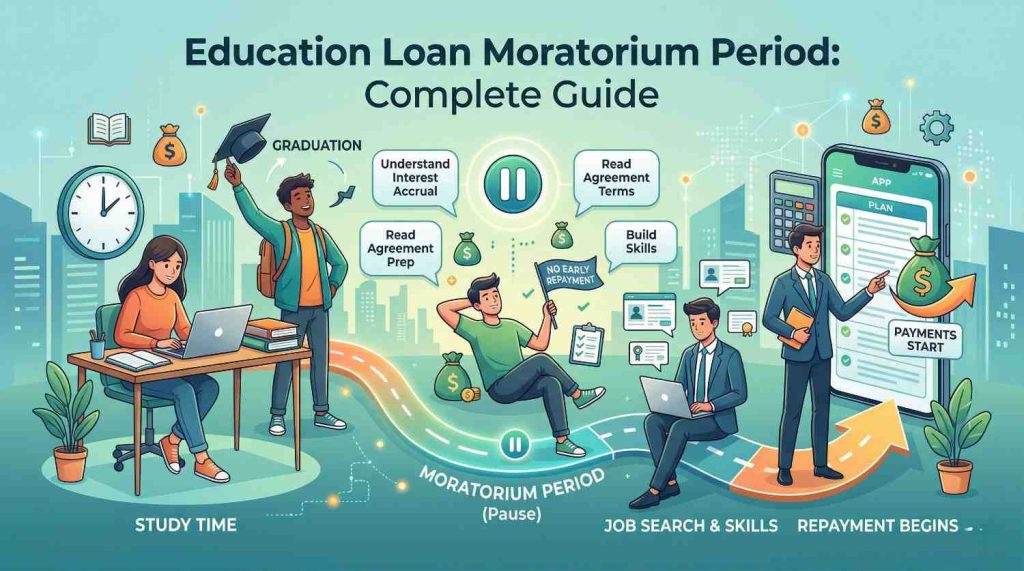
The moratorium period in an education loan is a specific window of time during which a borrower is not required to make any EMI payments. Think of it as a scheduled financial pause that the lender grants you while you complete your studies and get settled in a job.
In simple terms, your EMI clock does not start ticking the moment the bank disburses your loan. It starts only after the moratorium period is over.
A moratorium period in India is a designated timeframe during which a borrower is not required to make repayments towards the principal amount of a loan, although interest continues to accrue.
The key word there is “principal.” The principal repayment stops. But interest does not.
How Long Is the Moratorium Period?
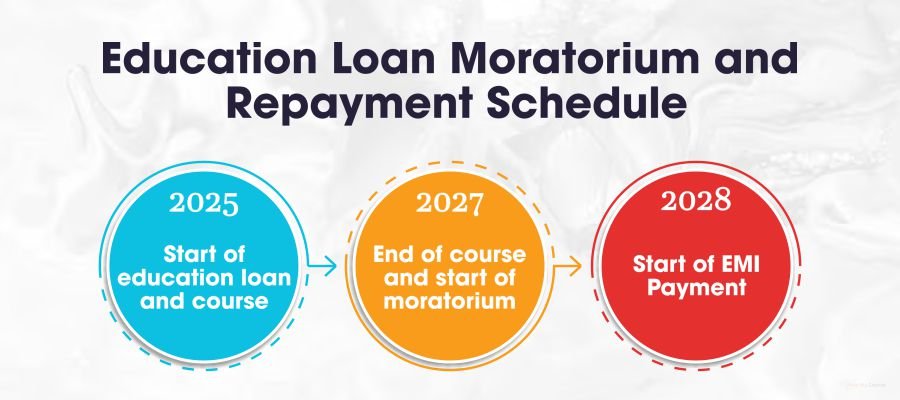
A moratorium period typically includes the duration of the education course plus an additional 6 to 12 months after course completion, depending on the lender.
So if you take a two-year MBA course and your bank offers a 12-month post-course grace period, your total moratorium period runs for three full years. Your EMIs begin only after that.
Here is a real-world example I find helpful: imagine a student named Priya who takes a Rs. 20 lakh loan in July 2024 for a two-year postgraduate programme. Her repayment will not start during her course; instead it starts 12 months after her course is completed, meaning she gets the full course period plus one year before the first EMI is due.
Why Does the RBI Mandate the Moratorium Period?
The Reserve Bank of India has mandated all government banks to provide a moratorium period on education loans. A model educational loan scheme was designed by the RBI, taking into account the financial challenges faced by eligible students pursuing studies abroad.
The logic is straightforward. A fresh graduate cannot be expected to start repaying a loan the day they finish their final exam. They need time to find employment, relocate if necessary, and stabilise their income. Without a moratorium period, the default risk for education loans would be much higher, and fewer students would even apply for them.
During the moratorium, students do not make repayments but they are not considered defaulters. This keeps their credit scores intact without the pressure of immediate repayment.
This is a critical protection for young borrowers. Your CIBIL score remains untouched during this period, even though you are making zero payments.
► MY POV: From what I have seen while researching this topic, the moratorium period is one of the most underappreciated features of an Indian education loan. Most students focus entirely on the interest rate when comparing lenders. But the post-completion grace period and whether the bank compounds or simply charges interest during this window can change your total repayment amount by several lakhs. I strongly recommend making this a primary comparison point before finalising your lender.

What Happens to Interest During the Moratorium Period?
This is the part most borrowers either misunderstand or overlook entirely. The moratorium period does not mean your loan sits quietly waiting for you. Interest continues to build.
Interest application during the moratorium period is based on the nature of the education loan. Some loan providers require borrowers to pay interest during the moratorium period, which results in a lower overall repayment amount. For others, the interest accumulated during the moratorium period is added to the principal amount of the loan, which can result in a higher overall burden of repayment.
There are two scenarios:
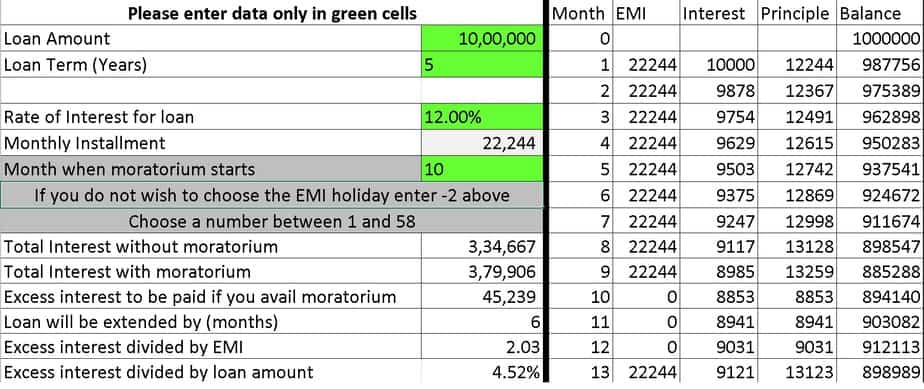
Scenario 1: You do not pay interest during the moratorium. The interest keeps accumulating. At the end of the moratorium period, all that accumulated interest gets added to your principal. Your EMIs then get calculated on this larger amount. This is called interest capitalisation, and it inflates your total repayment significantly.
Scenario 2: You pay simple interest during the moratorium. Only simple interest is charged during the moratorium period. After the moratorium period, the actual interest mentioned in the loan agreement is charged. If you pay off this simple interest as it accrues, your EMIs will be based only on your original principal. This approach saves you a meaningful amount over the loan’s life.
Read More: Education Loans Without Collateral For Studying Abroad
A Concrete Number to Consider
Consider a student who takes an education loan of Rs. 30 lakh for a 2-year course at an 8.5% interest rate. During the moratorium period, simple interest is charged. On Rs. 10 lakh, at 3% interest for one year under the PM Vidyalaxmi scheme, the interest works out to Rs. 30,000, with the central government paying this subsidy amount.
The takeaway is clear: the government subsidy exists precisely to help students manage this interest burden during the moratorium.
Bank-wise Moratorium Period Rules in India
Not all banks offer the same moratorium terms. Here is a comparison of major lenders:
| Bank / Lender | Moratorium Duration | Interest During Moratorium |
|---|---|---|
| SBI (Student Loan) | Course + 12 months | Simple interest (optional payment) |
| SBI (Global Ed-Vantage) | Course + 6 months | Simple interest |
| Bank of Baroda | Course + 12 months | Simple interest |
| Canara Bank | Course + 12 months | Simple interest |
| HDFC Credila | Course + 12 months | Varies by agreement |
| Private Banks (general) | Course + 6 to 12 months | Partial or full interest may be required |
| NBFCs (e.g. Propelld) | Varies; more flexible | Interest payments often required immediately |
SBI-Specific Moratorium Rules
In the case of education loans for study in India, repayment starts after the completion of the course period and moratorium period. Repayment commences one year after course completion or six months after securing a job, whichever is earlier. In the case of education loans for study abroad, repayment starts six months after course completion.
SBI offers a 1% concession in interest throughout the loan tenure if the borrower pays back the interest amount during the course and moratorium period. This is a concrete incentive to stay financially active during the moratorium rather than letting interest pile up.
Government Schemes That Support Students During the Moratorium
India has several active schemes that reduce or eliminate the interest burden during the moratorium period for eligible students. This is where a lot of money can be saved.
Central Sector Interest Subsidy (CSIS)
The Department of Higher Education has been implementing the Central Sector Interest Subsidy scheme since 2009. Under this scheme, interest subsidy is given during the moratorium period, meaning the course period plus one year, on education loans taken from scheduled banks under the Model Education Loan Scheme of the Indian Banks Association to students from economically weaker sections whose annual parental income is up to Rs. 4.5 lakh from all sources.
Under the CSIS scheme, the government pays the interest during the moratorium period for students from economically weaker sections.
PM Vidyalaxmi Scheme (2024)
This is the newer, broader scheme launched by the central government.
The PM Vidyalaxmi scheme provides financial support to meritorious students so that financial constraints do not prevent India’s youth from pursuing quality higher education. A special loan product has been introduced to enable collateral-free, guarantor-free education loans to meritorious students who gain admission to top quality higher educational institutions, with the process entirely digital. For students with up to Rs. 8 lakh annual family income, the scheme provides a 3% interest subvention on loans up to Rs. 10 lakh.
This 3% interest subvention during the moratorium can save families tens of thousands of rupees over the loan period.
Dr. Ambedkar and Padho Pardesh Schemes
The Dr. Ambedkar Interest Subsidy Scheme provides an interest subsidy during the moratorium period for OBC and EBC students heading abroad for higher studies. The Padho Pardesh Scheme offers similar interest subsidies during the moratorium for students from minority communities pursuing overseas education.
What Others Miss: Most articles talk about CSIS but completely overlook the PM Vidyalaxmi scheme launched in 2024, which extends the income eligibility ceiling to Rs. 8 lakh. This means a much larger number of middle-class Indian families now qualify for moratorium interest relief than before.
Education Loan Moratorium Period vs Grace Period: Clearing the Confusion
Many students use these terms interchangeably. They are not the same.
A grace period is a set duration after an outstanding payment is due, during which a payment can be made without any penalty charged. A moratorium period, on the other hand, is a pre-agreed repayment holiday built into the loan structure from the start.
In other words, a grace period is reactive, it applies after you have already missed a payment. A moratorium period is proactive, it is a planned, structured pause that starts the moment your loan is sanctioned.
The moratorium period also has no penalty implications. A grace period, if exceeded, typically results in late fees or a negative mark on your credit report.
How Interest Accumulation Affects Your Total Repayment
Let me walk through a straightforward calculation to show you why paying interest during the moratorium makes financial sense.
Assume you take a loan of Rs. 15 lakh at 10% per annum for a 2-year course with a 1-year post-course moratorium. That means a 3-year moratorium total.
If you do not pay interest during moratorium: Simple interest for 3 years = Rs. 15 lakh × 10% × 3 = Rs. 4.5 lakh This Rs. 4.5 lakh gets added to your principal. Your new principal at EMI start = Rs. 19.5 lakh
If you pay interest during moratorium: Your principal at EMI start remains Rs. 15 lakh.
Over a 12-year repayment period, that Rs. 4.5 lakh difference compounds into a significantly higher total outgo. Paying interest during the moratorium, even in partial amounts, is nearly always the smarter financial choice.
► MY POV: I have spoken to parents who discovered this too late. They assumed the moratorium period meant the loan was completely frozen. It is not. My advice is this: if your family can manage even partial interest payments during the moratorium period, start doing so from month one. Even Rs. 5,000 per month paid toward interest during this period can save you significantly more in the long run.
Moratorium Period for Study Abroad vs Study in India
The rules differ depending on where you are studying.
For education loans for study abroad, repayment starts after the completion of the course period and moratorium period, which begins six months after course completion for SBI’s Global Ed-Vantage loan.
For study abroad aspirants, the moratorium becomes particularly important because it accounts for the time needed to secure employment after graduation. Different lenders offer varying moratorium structures.
The shorter 6-month post-course grace period for study-abroad loans reflects the expectation that students graduating from foreign universities typically enter employment faster. However, private lenders may negotiate different terms based on your course duration and destination country.
Common Mistakes to Avoid During the Moratorium Period
1. Assuming interest is frozen. Interest keeps accruing from the day of first disbursement. Many students discover this only when they see the loan statement at the end of the course.
2. Not checking whether the bank applies compound or simple interest. Most banks charge simple interest during the moratorium period, which is later added to the loan balance if not repaid. When this accrued interest is not repaid separately, it gets added to the principal balance, and the total loan becomes higher than originally projected.
3. Ignoring government subsidy applications. Many students from eligible families simply do not apply for CSIS or PM Vidyalaxmi because they are unaware of the process. Canara Bank is the nodal bank for these schemes. Check the PM Vidyalaxmi portal at pmvidyalaxmi.co.in for current eligibility details.
4. Confusing the moratorium with an EMI holiday. An EMI holiday granted mid-repayment (sometimes offered during financial stress) is a different product. The moratorium period is a pre-agreed, structured feature of your loan.
5. Not checking if an extension is possible. Most education loans automatically include a moratorium period in their terms. A formal request is required only if you wish to extend the moratorium beyond the standard period. If your course gets extended or you need more time to find a job, contact your bank before the moratorium ends, not after.
6. Missing the tax benefit. Interest paid on education loans is eligible for deduction under Section 80E of the Income Tax Act. This applies to interest paid after the moratorium ends, for up to 8 consecutive years. Claim it diligently.
Conclusion
The education loan moratorium period is one of the most important features of any student loan in India. It protects you from the impossible pressure of repaying a loan before you have even finished your degree, and it gives you a runway to find employment after graduation.
But it is not a free pass. Interest keeps building, and the choices you make during this period, whether to pay interest or let it compound, whether to apply for a government subsidy, whether to check the fine print on your specific bank’s terms, all have real financial consequences.
My final recommendation is this: treat the moratorium period as an active financial phase, not a passive one. Understand how your lender handles interest during this time, explore government subsidy schemes if your family qualifies, and if possible, make at least partial interest payments to keep your eventual EMI manageable.
A well-managed moratorium period means you start your professional life with a loan you can handle, not one that controls you.
How Gradsloan Helps You Get the Right Education Loan
If the education loan process feels overwhelming, you are not alone. Most families spend weeks comparing lenders, gathering documents, and chasing approvals. Gradsloan simplifies all of that. Headquartered in Noida and serving students across India, Gradsloan matches you with the right lender based on your academic profile and loan requirement, whether domestic or abroad. Their team manages documentation, lender coordination, and follow-ups from start to finish. With deep knowledge of varying bank policies across India, they reduce your rejection risk and save you time when it matters most.
Frequently Asked Questions
What is the moratorium period in an education loan in simple terms?
It is the period during which you do not have to pay EMIs on your education loan. It starts from the date of loan disbursement and typically ends 6 to 12 months after you complete your course. The loan exists during this period, and simple interest continues to build, but you are not required to make any repayments.
Does interest really accrue during the moratorium period?
Yes. Interest accrued during the moratorium will be treated as additional principal on the borrower’s education loan if it remains unpaid. When the moratorium has ended and accrued interest is not repaid separately, it gets added to the principal balance, resulting in higher monthly payments. Paying simple interest during this period, even optionally — keeps your ultimate EMI lower.
What is the moratorium period for SBI education loans?
For SBI’s standard student loan, the repayment holiday covers the course period plus one year after course completion, or a few months after securing employment, whichever comes first. The repayment period can extend up to 15 years. For the Global Ed-Vantage scheme for study abroad, the post-completion period is 6 months.
Can I extend the moratorium period if I do not find a job in time?
Yes, in most cases you can request an extension. You need to approach your lender with supporting documentation before the moratorium ends. Banks typically consider extensions on a case-by-case basis. Do not wait until after the moratorium expires to ask.
What happens to my CIBIL score during the moratorium period?
A borrower’s CIBIL score remains unchanged during the moratorium period, even though no repayments are made. This ensures borrowers don’t default on their loans in the credit record during this time.
Who qualifies for interest subsidy during the moratorium period?
Students from economically weaker sections with annual parental income up to Rs. 4.5 lakh qualify for full interest subsidy under the CSIS scheme. Under the newer PM Vidyalaxmi scheme, students with annual family income up to Rs. 8 lakh can get a 3% interest subvention on loans up to Rs. 10 lakh. The course must be from an approved, NAAC-accredited or NBA-accredited institution.
Is it better to pay interest during the moratorium or wait until EMIs begin?
Paying interest during the moratorium is almost always financially better. If you pay simple interest as it accrues, your EMI is calculated only on the original principal. If you let interest accumulate, it gets added to the principal, increasing your EMI and your total repayment. The difference over a 12-15 year loan can run into lakhs.