Every year, thousands of Indian students watch their dream of higher education slip away, not because they lack talent, but because they lack funds. Banks move slowly. Paperwork stacks up. Deadlines pass. That is exactly why the NBFC education loan has become the go-to solution for students who need fast, flexible financing in 2026.
In my research across dozens of loan products and lender websites, I found that NBFCs consistently outperform traditional banks on three things: speed, flexibility, and accessibility. If you are an Indian student planning to study in India or abroad and wondering whether an NBFC is the right route, this guide gives you everything you need to decide.
Key Takeaways
- NBFCs offer faster approval, broader course coverage, and collateral-free loans up to ₹75 lakhs.
- Interest rates range from approximately 9.95% (secured) to 16% (unsecured) depending on lender and profile.
- Top NBFCs in India for education loans include Credila, Avanse, Auxilo, Tata Capital, and InCred.
- Always check for government interest subsidy schemes before finalizing any lender.
- Choose NBFCs when speed, flexibility, and collateral-free funding matter most; consider banks when long-term rate savings are the priority.
What Is an NBFC Education Loan and Why It Matters in 2026
A Non-Banking Financial Company, or NBFC, is a financial institution regulated by the Reserve Bank of India that offers loan and credit services without holding a full banking license. The key difference from banks is that NBFCs cannot accept demand deposits such as savings or current accounts, but they absolutely can disburse education loans, and they do it faster than most banks ever will.
For students, NBFCs have emerged as a vital source of education financing, offering more flexible terms, faster processing, and wider course coverage compared to traditional banks, making higher education loans more accessible.
What makes this relevant right now? According to the global credit rating agency CRISIL, NBFC education loans are projected to experience a significant growth of up to 40% in financial year 2023-24. That momentum has only grown stronger heading into 2026, with more lenders entering the space and loan products becoming more student-friendly than ever before.
Quick Facts Table: NBFC Education Loan at a Glance
| Feature | Details |
|---|---|
| Interest Rate (Secured) | Starts at ~9.95% p.a. |
| Interest Rate (Unsecured) | Starts at ~11.25% p.a. |
| Loan Amount (Unsecured) | Up to ₹75 lakhs |
| Repayment Tenure | 10 to 15 years |
| Processing Time | 7 to 10 days (some in 72 hours) |
| Collateral Required | Optional (varies by lender) |
| Eligible Age | 18 to 35 years |
| Tax Benefit | Section 80E deduction on interest |
Top NBFCs for Education Loan in India: A Detailed Comparison
This is the section most articles get wrong. They list names without giving you enough detail to compare. I have broken this down so you can match the right lender to your actual situation.
Credila Financial Services (Formerly HDFC Credila)
Credila Financial Services Limited is one of India’s largest education loan NBFCs and has funded over 2.26 lakh students across 64 countries and 5,200+ universities as of March 2025. Interest rates start at 10.25% for secured loans and 11.50% for unsecured loans. Credila is particularly strong for students heading to top-ranked universities abroad, and in my analysis, its pre-admission sanction letter feature is one of the most underrated tools available to Indian students during the visa application process.
Avanse Financial Services
Avanse is known for tie-ups with 1,550+ universities and covers 100% of education expenses, including ancillary costs like laptops and exam fees. Avanse calculates its interest rate as Base Rate plus Spread, with a current Base Rate of 14.55% as of December 2024. The spread varies based on your academic profile and the university you are enrolling in. Avanse is particularly reliable for students needing emergency fund disbursals, they can process funds within 3 working days.
Auxilo Finserve
Auxilo is one of the newer players but has built a strong reputation by approving loans for students pursuing non-mainstream courses that most banks reject outright. NBFCs like Auxilo are more open to lending for courses other than the ones in the mainstream. If you are pursuing fashion design, hospitality, animation, or creative arts, Auxilo is worth shortlisting.
Tata Capital
Backed by the trusted Tata brand, Tata Capital offers swift and reliable services with minimum income criteria and loan disbursal within 72 hours. Secured loan rates start at 11.50% and unsecured at 12.00%. The Tata brand brings a trust factor that matters to co-applicants, especially parents who are unfamiliar with newer-age lending companies.
InCred Financial Services
InCred allows education loans to all aspiring students, and providing collateral can typically get you a better rate, a higher loan amount, and can improve your chances of approval. InCred is a solid option if your co-applicant has a strong income history but limited assets.
► MY POV: In my experience comparing these five lenders, Credila edges ahead for students applying to top global universities, while Avanse wins on flexibility for mid-tier international colleges. For purely domestic studies, Auxilo and InCred are criminally underrated options that most students overlook because they focus only on the big names. Do not make that mistake.
NBFC Education Loan Interest Rates in 2026: What You Actually Pay
Interest rate comparison is where most students make their biggest financial mistake. They look at the starting rate and stop there. The real number you need to calculate is the total interest outgo over the full repayment period, not just the monthly EMI.
Secured education loans through NBFCs like HDFC Credila start from around 9.95% per annum, while unsecured loans without collateral start from approximately 11.25% per annum.
Interest rates charged by NBFCs generally range from 10% to 14%, depending on factors like loan amount, repayment capacity, and co-applicant income.
Here is what most articles miss: the spread component. Most NBFCs use a Base Rate plus Spread model, meaning your final rate is not fixed at the advertised figure. Your academic record, university ranking, co-applicant income, and even your entrance exam score all influence the spread. A student admitted to an IIT or IIM can qualify for the lower end of the band. A student at an unranked private college will pay the higher end.
What Others Miss: The Government Subsidy Angle
The Central Sector Interest Subsidy (CSIS) scheme is designed for students from economically weaker sections. If your family’s annual income is up to ₹4.5 lakh, the government pays the interest on your education loan during the entire moratorium period, meaning no interest builds up during your 3 or 4-year degree. For students with up to ₹8 lakh annual family income, the Ministry of Education’s scheme provides a 3% interest subvention on loans up to a specified limit, as announced in March 2026.
Most students taking NBFC loans do not check whether they qualify for these subsidies. That is a costly oversight.
NBFC Education Loan Without Collateral: Is It Really Possible?
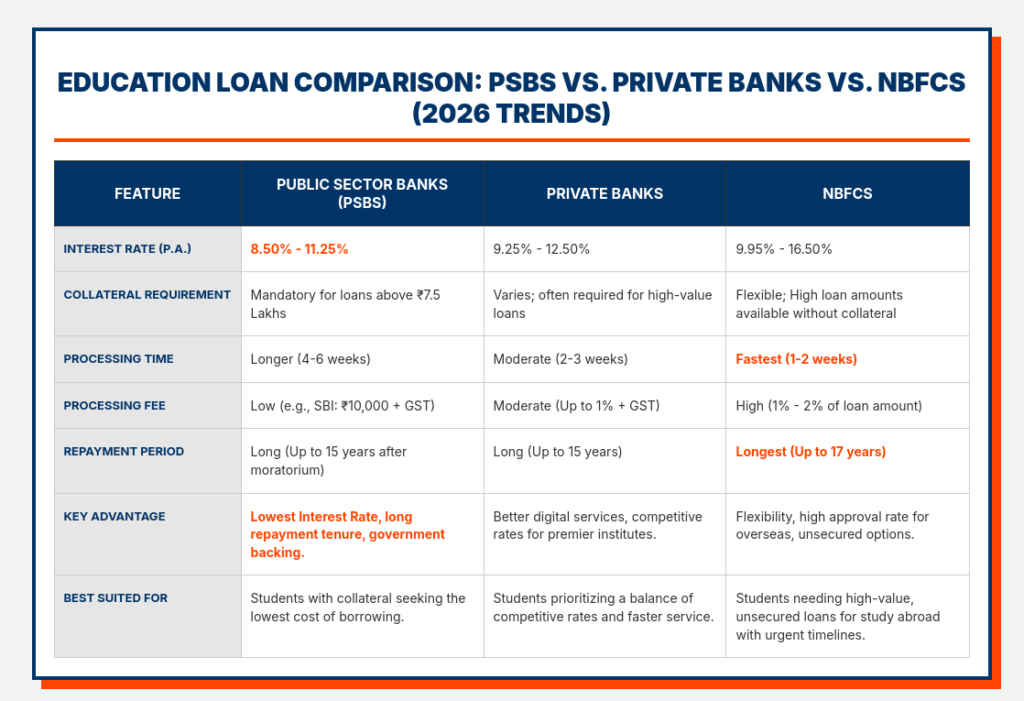
Yes, and this is arguably the biggest reason students are choosing NBFCs over banks in 2026. NBFCs primarily offer unsecured education loans, eliminating the need for collateral, evaluating academic performance and earning potential over assets.
For unsecured loans, NBFCs offer up to ₹75 lakhs without pledging any assets. That is a significant sum, enough to cover most international master’s programs in the USA, UK, Canada, or Australia.
The catch? For collateral-free loans, NBFCs may require a co-applicant with a stable income and a good credit history. The co-applicant’s CIBIL score and income stability become the primary risk assessment factors in place of property or fixed deposits.
Eligibility criteria for an NBFC education loan without collateral typically includes:
- Indian citizenship, aged between 18 and 35 years
- Confirmed admission to a recognized institution in India or abroad
- Strong academic record (percentage, entrance exam score)
- Co-applicant with stable income and a CIBIL score above 700
- Valid KYC documents and income proof of co-applicant
- Admission letter and fee structure from the university
NBFC vs Bank Education Loan: Which One Should You Choose?
This is the comparison most students need but rarely get in a clear, side-by-side format. Here is my honest breakdown:
| Parameter | NBFC | Public Sector Bank |
|---|---|---|
| Processing Speed | 7-10 days (some 72 hours) | 15-45 days |
| Interest Rate | 10% to 16% | 8% to 11% |
| Collateral Flexibility | High (collateral-free up to ₹75L) | Moderate |
| Course Coverage | Wide (non-mainstream included) | Limited |
| Moratorium Period | Varies by lender | Usually available |
| Government Subsidies | Limited access | Full access |
| Tax Benefit (80E) | Available | Available |
| Loan Amount | Up to ₹75 lakhs (unsecured) | Up to ₹20-40 lakhs typically |
The honest truth is that neither is universally better. If speed matters more than rate, an NBFC like Avanse or Credila can get you a sanction letter much faster than SBI in many cases, which is critical when your visa application is time-sensitive. But if your timeline is relaxed and you qualify for government subsidies, a public bank can save you significant money over the loan tenure.
► MY POV: I firmly believe Indian students underestimate how much faster NBFCs move, and they pay for it with missed admission deadlines and delayed visa applications. The interest rate difference between an NBFC and SBI sounds large on paper, but when I calculated the actual EMI difference on a ₹20 lakh loan over 10 years, it often works out to a few hundred rupees per month. For many students, that difference is worth buying back the speed and flexibility.
India-Specific Angle: NBFC Education Loans for Domestic Studies
Most articles focus exclusively on abroad studies. But NBFCs are equally valuable for students pursuing higher education within India, particularly for:
- Private engineering or medical college fee payments
- MBA programs at private B-schools
- Vocational or skill-based certifications
- Correspondence or part-time degree programs
NBFC education loans cover a wide array of courses, from traditional degrees to international programs, with 100% financing for all expenses. Students at private Indian universities often find that banks reject their applications because the institution is not on the approved list. NBFCs apply a broader eligibility lens based on the student’s profile, not just the institution’s rank.

How to Apply for an NBFC Education Loan: Step-by-Step
Applying for an NBFC education loan is simpler than most students expect. Here is the process I have seen work consistently:
Step 1: Research and shortlist 2-3 NBFCs based on your destination, course, and loan amount requirement. Do not apply to all of them at once, multiple hard inquiries in a short period can lower your co-applicant’s CIBIL score.
Step 2: Check your eligibility on the NBFC’s official website or through a loan aggregator platform. Most offer a quick online pre-qualification check.
Step 3: Gather your documents including your admission letter, fee structure, KYC documents, co-applicant’s income proof (salary slips or ITR), and academic marksheets.
Step 4: Submit your application online. Most NBFCs have fully digital application processes. Credila, Avanse, and InCred all offer end-to-end online submissions.
Step 5: Receive your sanction letter after credit appraisal, typically within 7 to 15 days. For visa purposes, request the sanction letter in a format acceptable to the concerned embassy.
Step 6: Loan disbursement usually happens directly to your institution in tranches, aligned with your fee payment schedule.
Source: Bajaj Markets (youtube)
Common Mistakes to Avoid When Taking an NBFC Education Loan
I have seen students make these errors repeatedly:
- Focusing only on interest rate: Ignoring processing fees, prepayment penalties, and spread calculations leads to unpleasant surprises at disbursement time.
- Not comparing the sanction letter carefully: Always verify the exact loan amount, disbursement schedule, and repayment start date before signing.
- Ignoring moratorium terms: Some NBFCs do not allow a moratorium on the payment of EMIs and carry higher interest rates than banks. Read the fine print about what you owe during your study period.
- Skipping government subsidy checks: As noted earlier, CSIS and other Ministry of Education schemes can effectively bring your interest cost to near zero if your family income qualifies.
- Using an unverified agent: Avanse, like other reputable NBFCs, explicitly warns that it will never ask you to transfer funds to unauthorized personal accounts or through QR codes. Always transact only through official channels.
Apply for Your Education Loan with Gradsloan
Getting the right education loan should never slow down your dreams. At Gradsloan, we help you find the best study loan tailored to your needs, whether you are planning to study in India or abroad. We compare top banks and NBFCs, so you get the lowest interest rates, fastest approvals, and the most flexible repayment options, all in one place. No confusing paperwork. No running between lenders. Just simple, expert guidance from application to disbursement. Thousands of Indian students have funded their higher education with our help. Ready to take the next step? Apply your education loan with Gradsloan today.
Conclusion: Making the Right Choice on Your NBFC Education Loan
The NBFC education loan market in India has matured significantly by 2026, giving students more options, better products, and faster access to funds than ever before. Whether you are funding a domestic MBA or a master’s degree in the United States, there is an NBFC product designed for your situation.
My advice: do not apply blindly to the most popular name. Compare at least two to three lenders, calculate total interest outgo over the full tenure, check your government subsidy eligibility, and read the sanction letter in full before signing anything.
Your education is the most valuable investment you will ever make. Choose the lender that makes that investment as efficient and affordable as possible.
DISCLAIMER: This article is for informational purposes only and does not constitute financial advice. Interest rates and loan terms are subject to change. Always verify current rates directly with the lender before applying.
Frequently Asked Questions About NBFC Education Loans
Which NBFC is best for education loan in India?
Credila is best for top-ranked international universities, Avanse for broader university tie-ups, and Auxilo for non-mainstream courses. The “best” NBFC depends on your destination, course, and co-applicant profile.
Can I get an NBFC education loan without collateral?
Yes. Most leading NBFCs offer unsecured loans up to ₹75 lakhs without pledging assets. A strong co-applicant with a good CIBIL score is typically required.
What is the interest rate for NBFC education loans in 2026?
Secured NBFC education loan rates start at around 9.95% per annum, and unsecured rates start from approximately 11.25% per annum. Rates vary based on your profile, institution, and loan amount.
Is NBFC education loan better than SBI?
NBFCs are faster and more flexible. SBI offers lower rates and access to government subsidies. If your timeline allows, SBI may save money. If you need quick disbursement, an NBFC is the better choice.
What documents are required for an NBFC education loan?
Typically: admission letter, fee structure, KYC documents, co-applicant’s income proof (salary slips/ITR for 2-3 years), academic marksheets, and bank statements.
Can I claim tax benefit on an NBFC education loan?
Yes. Under Section 80E of the Income Tax Act, individuals can claim a deduction on interest paid on education loans for themselves, their spouse, children, or legal ward, applicable under the old tax regime.
How long does it take to get an NBFC education loan approved?
Some NBFCs approve loans within 7 to 10 days, making them ideal for students who need funds urgently. Avanse can disburse within 3 working days in fast-track cases.
Sources and references:
- https://www.crisilratings.com/en/home/newsroom/press-releases/2024/09/education-loan-aum-of-nbfcs-to-top-rs-60000-crore-this-fiscal.html
- https://www.crisilratings.com/en/home/newsroom/press-releases/2025/07/for-nbfcs-education-loan-aum-growth-to-halve-amid-us-headwinds.html
- https://ddnews.gov.in/en/indian-nbfcs-to-clock-25-pc-growth-in-education-loan-aum-in-fy26-amid-us-uncertainties/
- https://propelld.com/site/blog/nbfc-education-loan
- https://www.gyandhan.com/blogs/education-loans-from-nbfcs
- https://www.elanloans.com/blogs/nbfc-education-loan-for-abroad-studies
- https://www.credila.com/article/section-80e-tax-benefits-on-education-loan
- https://www.avanse.com
- https://moneyview.in/loan-insights/top-education-loan-providers-in-india
- https://cleartax.in/s/section-80e-deduction-interest-on-education-loan
- https://www.policybazaar.com/income-tax/section-80e-income-tax-deduction/