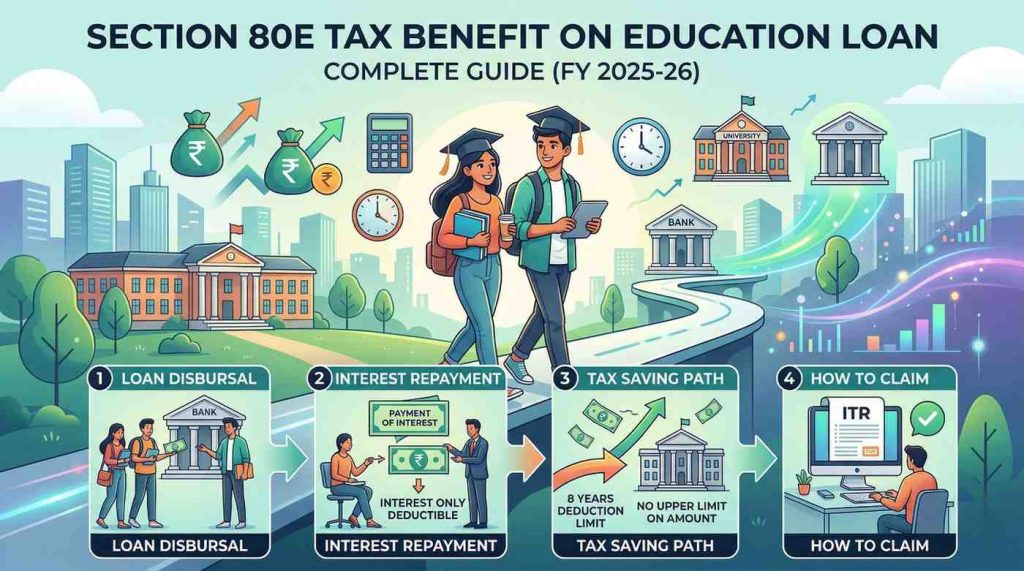
Key Takeaways: Section 80E at a Glance
- Section 80E allows a full deduction on education loan interest with no upper cap, making it uniquely powerful compared to most other deductions.
- Only individual taxpayers can claim this benefit. HUFs, companies, and firms are excluded.
- The loan must be from a recognised bank, NBFC, or approved charitable institution. Informal loans do not qualify.
- The deduction applies to loans taken for higher education of self, spouse, children, or legal ward, whether studied in India or abroad.
- The deduction is available for a maximum of 8 consecutive years from the year repayment begins, or until full repayment, whichever is earlier.
- Section 80E is only available under the Old Tax Regime. Filing under the New Regime forfeits this benefit entirely.
- Obtain your interest certificate from your lender every April and file your ITR accordingly.
Introduction
Every year, thousands of Indian students and parents repay education loans without realising they are sitting on a tax-saving opportunity that has no upper limit. No cap. No ceiling. Just the full interest amount you paid in a year, deducted straight from your taxable income.
Section 80E of the Income Tax Act, 1961 is that provision. It exists specifically to reduce the financial pain of repaying a higher education loan. In my experience reviewing tax-saving options for salaried Indians, this is one of the most underused deductions in the entire Income Tax Act, primarily because most people assume it has a limit like Section 80C.
It does not. And that single fact changes the calculation for every family with an education loan in repayment right now.
This complete guide covers everything you need to know about Section 80E: what it covers, who qualifies, the 8-year rule, worked calculation examples, how to claim it, and the critical regime choice you must make in FY 2025-26.
Quick Facts: Section 80E at a Glance
| Feature | Details |
|---|---|
| Applicable Act | Income Tax Act, 1961 — Chapter VI-A |
| What is deductible | Interest paid on education loan (not principal) |
| Deduction limit | No upper limit — full interest amount claimable |
| Who can claim | Individual taxpayers only (not HUFs or companies) |
| Loan taken for | Self, spouse, children, or legal ward |
| Eligible loan source | Recognised bank, financial institution, or approved charitable trust |
| Claim period | Maximum 8 years from year repayment begins |
| Tax regime | Old Tax Regime only — not available under New Regime |
| Foreign education | Eligible, if loan is from an Indian financial institution |
| Principal repayment | Not eligible under Section 80E |
What Is Section 80E of the Income Tax Act?
Section 80E is a provision under Chapter VI-A of the Income Tax Act. Its objective is to promote higher education by reducing the burden of interest payments through tax savings on education loans. It allows individual taxpayers to claim a deduction on the interest paid on an education loan, making it easier to manage loan repayments without additional financial strain.
In plain terms: when you pay an EMI on your education loan every month, that EMI has two parts. One part goes toward the principal (the original amount you borrowed). The other part is interest (the cost of borrowing). A deduction under this section applies to interest payments only and not to capital repayments.
The interest portion of every EMI you pay in a financial year qualifies for deduction from your gross total income. The amount of deduction allowed in a financial year is the entire amount of interest paid on the education loan during that year. There is NO upper monetary limit on the amount of interest that can be claimed as a deduction under Section 80E.
This makes Section 80E fundamentally different from Section 80C, which caps deductions at ₹1.5 lakh. Under 80E, whether you pay ₹50,000 or ₹5 lakh in interest during the year, you can claim every rupee.
Read More: Education Loan Moratorium Period: What It Really Means for Indian Students in 2026
What Others Miss: The “No Cap” Advantage for Large Loans
Most articles mention the no-limit feature but fail to quantify what it actually means. Consider a parent who took a ₹20 lakh loan for their child’s MBBS or MBA abroad. At a 10% annual interest rate, the first-year interest alone can exceed ₹2 lakh. Under 80C, ₹2 lakh buys you only partial relief because the section caps at ₹1.5 lakh. Under Section 80E, that full ₹2 lakh reduces your taxable income with no ceiling whatsoever. For someone in the 30% tax bracket, that is a tax saving of ₹60,000 in a single year.
► MY POV: The no-limit structure of Section 80E is one of the most powerful but least understood features in Indian personal taxation. I have spoken with many salaried professionals who were meticulously maximising their 80C investments but completely ignoring 80E even while actively repaying an education loan. That is money left on the table every single year. If you or your spouse has an education loan in repayment right now and you are on the old tax regime, this deduction should be your first priority, not an afterthought.
Section 80E Eligibility: Who Can Claim This Deduction?
Not every taxpayer or every loan automatically qualifies. The law sets specific eligibility conditions, and understanding each one saves you from a rejected claim at the time of assessment.
Who Can Claim
Section 80E applies only to individual taxpayers. That means Hindu Undivided Families (HUFs), firms, or companies cannot claim it. You can claim the deduction if the loan is taken for yourself, your spouse, your children, or even a legal ward who depends on you.
Senior citizens who are individual taxpayers and meet all other conditions can also claim this deduction.
Loan Source Requirement
There is an important condition: the loan must come from a recognized bank, financial institution, or an approved charitable trust. Loans from friends, relatives, or unregistered lenders do not qualify.
This rules out informal borrowings from family members, employer advances, or money borrowed from unregistered lenders, regardless of what the borrowed amount was used for.
Course Eligibility
Higher studies include any course undertaken after completing senior secondary education or its equivalent, covering both regular and vocational programmes. This scope is broad. Engineering, medicine, management, law, architecture, professional certification courses, and vocational programmes pursued after Class 12 all qualify. The benefit is not limited to Indian courses alone. Education loans for both domestic and foreign studies qualify under Section 80E.
Tax Regime Condition
For FY 2025-26, Section 80E is only available in the Old Tax Regime. If you stick with the New Tax Regime (the default one), you lose this deduction. This is arguably the most important condition for taxpayers to be aware of in 2026, given that the New Tax Regime has become the default filing option.
Section 80E Deduction Limit and the 8-Year Rule
The Deduction Limit (Or the Absence of One)
There is no maximum or minimum deduction limit specified under Section 80E, provided that deductions are claimed only for 8 years. The deduction amount on interest payment is not impacted by the interest rate charged by the financial or charitable institution, the amount of the loan, or any other factor.
This means your full interest payment for the financial year, regardless of the figure, is eligible. The bank’s interest certificate will confirm the exact interest component for you.
The 8-Year Rule Explained
The deduction for education loan interest under Section 80E begins from the year you start repaying the loan. It is available for a maximum of eight years or until the interest is fully repaid, whichever comes first. If the loan is fully repaid in five years, the deduction is allowed only for those five years. If the repayment period exceeds eight years, no deduction can be claimed beyond the eighth year.
This rule has a direct implication for loan structuring. Many borrowers with large loans choose a longer tenure for lower EMIs, but if that tenure crosses 8 years from the start of repayment, the interest paid after year 8 receives no tax benefit. If your education loan interest is very high, the Old Regime might still be your best friend. Spend a few minutes with a tax calculator or your advisor to see if the 80E advantage outweighs the lower slabs of the New Regime.
Section 80E with Example: How the Calculation Works
Understanding Section 80E becomes much clearer with actual numbers. Here are three practical worked examples.
Example 1: Salaried Employee, Self-Loan
Rahul is a software engineer in Pune earning ₹9 lakh per year. He is repaying an education loan he took for his own MBA. In FY 2025-26, the interest component of his EMIs totalled ₹1,20,000.
| Item | Amount |
|---|---|
| Gross Annual Income | ₹9,00,000 |
| Standard Deduction | ₹75,000 |
| Section 80C Deduction | ₹1,50,000 |
| Section 80E Deduction (interest paid) | ₹1,20,000 |
| Net Taxable Income | ₹4,55,000 |
Without the 80E deduction, Rahul’s taxable income stands at ₹5,75,000. With it, the income drops to ₹4,55,000, keeping him in the 5% slab and saving him approximately ₹24,000 in taxes in that single year.
Example 2: Parent Claiming for Child’s Abroad Education
Shivam is a regular salaried IT executive living in Mumbai. His 19-year-old son, Aman, is pursuing engineering from one of the reputed colleges. Shivam took an education loan of ₹10 lakh to fund Aman’s college fees for 4 years. Shivam has taken the loan for a period of 6 years, and in this duration, he can claim a deduction of interest paid on the loan taken for higher education under Section 80E.
Because the loan tenure (6 years) falls within the 8-year window, Shivam can claim every year of interest without any disruption to his tax benefit.
Example 3: The 8-Year Limit in Action
Mr. John started repaying interest on his education loan in FY 2024-25. His deduction is available for interest paid from FY 2024-25 up to FY 2031-32 (8 consecutive years). No deduction under Section 80E is available for the interest paid in FY 2032-33, as the 8-year period has expired.
This example shows why structuring your loan tenure carefully matters as much as the interest rate itself.
Section 80C vs Section 80E: Key Differences
Many taxpayers confuse Section 80C and Section 80E because both relate to education expenses. They are completely separate provisions.
| Feature | Section 80C | Section 80E |
|---|---|---|
| What it covers | Tuition fees paid, investments (PPF, ELSS, LIC) | Interest paid on education loan |
| Deduction limit | Capped at ₹1,50,000 | No upper limit |
| Principal repayment | Not covered under 80E (some items under 80C) | Not eligible |
| Who can claim | Individuals and HUFs | Individuals only |
| Eligible expenses | Tuition fees for up to 2 children | Loan interest for self, spouse, children, legal ward |
| Duration | Annual, ongoing | Maximum 8 years from repayment start |
| New Regime | Not available | Not available |
No, 80C covers tuition fees and investments with a cap, while 80E covers education loan interest with no upper limit. You can claim both simultaneously as long as you are on the old tax regime, and they apply to different expenses entirely.
Section 80E and the New Tax Regime: The Critical Decision for 2026
This is the section that most competing articles handle poorly, and it is the decision that matters most for taxpayers in FY 2025-26.
Under the new tax regime, most deductions and exemptions available in the old regime are not allowed. Section 80E is not available under the new tax regime. Taxpayers choosing the new regime cannot claim deductions for education loan interest, making it important to weigh the tax-saving benefits of the old regime if claiming Section 80E significantly reduces taxable income.
The New Tax Regime became the default option from FY 2023-24 onwards. If you do not actively opt for the Old Regime at the time of filing, you automatically fall under the New Regime and forfeit your Section 80E claim for that year.
For salaried employees, this means submitting a declaration to your employer (HR or payroll team) at the start of the financial year confirming your choice of the old regime. Provide your bank’s interest certificate alongside this declaration so the employer can adjust TDS accordingly.
The practical question is: which regime saves you more money? There is no universal answer. The answer depends on your income slab, your total deductions (80C + 80E + HRA + others), and your loan interest amount. Use a reliable online tax calculator or consult your CA with your actual numbers before deciding.
How to Claim Section 80E Deduction: Step-by-Step
The process is straightforward if you have the right document in hand.
Step 1: Obtain the Interest Certificate from your lender. Request this from your bank, NBFC, or lending institution at the end of each financial year. This certificate should have separate descriptions of interest and the principal amount of the education loan for that specific financial year. In this way, there will not be any tax benefit for the principal amount; instead, the interest is eligible for the same.
Step 2: Note the exact interest figure for the financial year. Your interest certificate will show month-by-month breakdowns. Use the total interest figure for the full financial year (April to March).
Step 3: File your ITR under the Old Tax Regime. While e-filing on the income tax portal, navigate to Deductions under Chapter VI-A. Enter your Section 80E interest amount in the designated field. This automatically reduces your gross total income by that amount before tax is calculated.
Step 4: Maintain all documentation. Keep the interest certificate, loan sanction letter, and proof of course enrollment safely. Keep the interest certificate and loan statement safely as proof; they must be produced if requested by the Assessing Officer.
Step 5: Inform your employer for TDS adjustment. If you want your company to deduct less TDS from your monthly salary, you should provide the bank’s interest certificate to your HR. This adjusts your monthly TDS rather than waiting for a refund after filing.
Common Mistakes to Avoid When Claiming Section 80E
Claiming under the new tax regime. Section 80E is strictly an old regime benefit. If you filed under the new regime assuming the deduction would apply, it does not. This is one of the most common errors in education loan tax filing.
Claiming the principal repayment as well. Only the interest component of your EMI qualifies. The principal has no tax benefit under Section 80E at all. Your bank’s interest certificate will separate these two figures clearly.
Borrowing from relatives and expecting to claim. Loans from parents, siblings, friends, or informal lenders do not qualify. Loans taken from friends or relatives for higher education do not qualify for this deduction. The loan must come from a recognised financial institution or approved charitable trust.
Missing the 8-year window without tracking. If you started repayment in FY 2018-19, your last eligible year is FY 2025-26. After that, the deduction expires regardless of whether the loan is still being repaid. Track your repayment start year carefully.
Skipping the deduction assuming the amount is “too small” to matter. Even ₹30,000 in annual interest saves you ₹9,000 in tax if you are in the 30% bracket. Over 8 years, that compounds into significant savings.
Conclusion
Section 80E remains one of the most generous tax provisions in the Indian Income Tax Act. No other deduction allows you to claim an unlimited amount from your taxable income. For families managing large education loans for professional courses in medicine, engineering, management, or overseas studies, this deduction can translate into meaningful savings of tens of thousands of rupees every year.
The single most important step you can take right now: check your loan repayment start year. If you are within the 8-year window and on the old tax regime, request your interest certificate from your bank and claim every rupee of interest paid this financial year.
If you are currently on the new tax regime and have an active education loan, run a proper comparison with actual figures before the next assessment year. The 80E deduction might make the old regime the better choice for your specific tax situation.
Start by getting your interest certificate. Everything else follows from there.
Disclaimer: This article is for informational purposes only and does not constitute professional tax or financial advice. Tax rules change frequently. Always consult a qualified Chartered Accountant or tax advisor before filing your returns.
Frequently Asked Questions About Section 80E
Q1. What is Section 80E of the Income Tax Act?
Section 80E allows individual taxpayers to claim a deduction from their gross taxable income for the interest paid on an education loan taken for higher studies. The deduction has no upper limit and can be claimed for a maximum of 8 years from the year repayment begins. It is available only under the Old Tax Regime.
Q2. What is the 80E deduction limit?
There is no upper limit on the deduction under Section 80E. You can claim the entire interest amount you paid during the financial year. Whether your annual interest is ₹40,000 or ₹4 lakh, the full amount is eligible as a deduction from your taxable income.
Q3. Can I claim Section 80E under the new tax regime?
No. The new tax regime does not provide deductions under Section 80E for education loan interest. You must opt for the Old Tax Regime to claim this benefit.
Q4. Can I claim both Section 80C and Section 80E in the same year?
Yes. Both sections cover different expenses. You can claim up to ₹1.5 lakh under 80C for investments and tuition fees, and separately claim the full education loan interest under 80E, as long as you are on the old tax regime.
Q5. Can I claim Section 80E if my child is studying abroad?
Yes. The deduction can be availed for foreign education loans as well. The assessee should be an Indian citizen, and the loan should have been taken from a recognized Indian financial institution or approved charitable institution. It does not matter that the course and college or university are from outside India.
Q6. What documents do I need to claim Section 80E?
You need the interest certificate from your lending institution, which separately states the principal and interest components of the loan paid during the financial year. Also keep your loan sanction letter and proof of course enrollment handy in case of assessment.
Q7. Can a parent claim Section 80E for their child’s education loan?
Yes. Irrespective of whether the loan is taken for himself or for his relative, the assessee can claim this deduction. Parents who have taken a loan for their child’s higher education and are making the repayments can claim the deduction in their own ITR.
Q8. What happens if I repay the loan in 5 years? Can I still claim for 8 years?
No. The deduction ends when the interest is fully repaid. If the loan is fully repaid in five years, the deduction is allowed only for those five years. The 8-year period is a maximum cap, not a guaranteed entitlement.