The USA costs roughly Rs.50 to Rs.90 lakh for a two-year master’s programme when you add tuition, accommodation, travel, health insurance, and living expenses. That number stops a lot of Indian families cold.
But here is what I have found after tracking thousands of student loan cases in the Indian market: the money is almost always available. The problem is not that education loans for USA studies are hard to get, it is that most students approach the wrong lender, apply too late, or submit incomplete documentation that delays everything right when visa timelines are tightest.
This guide covers every dimension of the education loan for USA studies, which lenders to approach, what interest rates you should actually expect in 2026, how to use your sanction letter for your F-1 visa and I-20, what MS and MBA students need to know differently, and the disbursement timeline that most students underestimate.
Key Takeaways
- Education loans for USA studies from Indian lenders range from Rs.20 lakh to Rs.1.5 crore, with rates between 10.15% and 13% depending on lender, university rank, and collateral.
- SBI Global Ed-Vantage offers the lowest rate (10.15% for female students, 10.40% for male) with a maximum tenure of 15 years, best for secured loans to recognised US universities.
- HDFC Credila, Avanse, and Auxilo offer faster processing and higher collateral-free loan limits, best when speed or large unsecured amounts are priorities.
- STEM MS students receive more favourable loan terms than non-STEM students because post-graduation employment data supports lower lender risk.
- Your final sanction letter is the key financial document for both your I-20 and your F-1 visa interview. Submit only a final sanction letter, not an in-principle letter, for visa purposes.
- Disbursement goes directly to your university for tuition. Apply at least 6 to 8 weeks before your first fee payment deadline.
- Interest accrues during moratorium. Paying even partial interest during your course prevents significant compounding that inflates your total repayment.
- Section 80E of the Income Tax Act allows full deduction of interest paid, a meaningful tax saving over the repayment tenure.
Quick Facts: Education Loan for USA Studies 2026
| Parameter | Details |
|---|---|
| Loan amount range | Rs.20 lakh to Rs.1.5 crore (Indian banks); up to USD 1 lakh (international lenders) |
| Interest rate range | 10.15% to 13% p.a. (Indian lenders); 11.99% to 18% (international lenders) |
| Lowest rate available | 10.15% — SBI Global Ed-Vantage (female applicants); 10.40% (male) |
| Best NBFC rate | From 9.95% — HDFC Credila (for top-ranked universities) |
| Collateral-free limit | Up to Rs.50 lakh (SBI, select universities); up to Rs.1.20 crore (Avanse, Credila) |
| Margin money requirement | 15% of total cost of attendance for abroad studies |
| Moratorium period | Course duration + 6 to 12 months (varies by lender) |
| Maximum repayment tenure | 15 years (SBI); 12 to 17 years (NBFCs) |
| Sanction letter accepted for | US F-1 visa, I-20, university admission confirmation |
| Tax benefit | Full interest deduction under Section 80E of Income Tax Act |
| Key lenders | SBI, HDFC Credila, Avanse, Bank of Baroda, Auxilo, InCred, Prodigy Finance |
Why an Education Loan for USA Studies Is Different From a Domestic Loan
Before I get into lender comparisons, it is worth understanding why USA education loans require a separate strategy entirely.
The amounts are larger, often five to ten times what a domestic loan covers. The tenure is longer, the documentation requirements are stricter, and the process is tightly linked to your US university’s timeline and your F-1 visa application date. A domestic education loan can afford some slack. A USA education loan cannot.
A 1% difference in interest rate on a Rs.60 lakh loan over 15 years means approximately Rs.6 lakh more or less in total repayment. That single fact explains why choosing the right lender for your USA studies is not a bureaucratic exercise, it is a financial decision that echoes for a decade and a half.
Three categories of lenders serve Indian students heading to the USA. Indian government banks (SBI, Bank of Baroda) offer the lowest rates and the highest trust factor with visa officials. Indian NBFCs (HDFC Credila, Avanse, Auxilo, InCred) offer faster processing, higher unsecured loan limits, and more flexible underwriting. International lenders (Prodigy Finance, MPOWER Financing) offer no co-applicant and no collateral requirements but charge significantly higher interest rates, typically 12% to 18%.
How Much Loan Can You Get for USA Studies?
The maximum amount you can borrow depends on the lender, your university, and whether you offer collateral.
What Expenses Does the Loan Cover?
A well-structured education loan for USA studies from an Indian lender covers the following:
- Tuition fees payable to the university each semester
- Accommodation costs (on-campus or off-campus)
- Economy class return airfare
- Books, laptop, lab equipment, and study materials
- Health insurance premiums (mandatory at most US universities)
- Visa application fees and SEVIS fee
- Library and exam fees
- Reasonable living expenses per semester
The total covered is called the Cost of Attendance (CoA), and the university itself publishes this figure. Your loan will typically be sanctioned based on this figure minus your margin money contribution.
Margin Money: The 15% Contribution
For education loans for study abroad, Indian banks require you to fund 15% of the total cost of attendance yourself. The bank finances the remaining 85%. This margin money can come from your savings, your parents’ fixed deposits, or a scholarship that reduces the outstanding amount.
For example, if your CoA is Rs.60 lakh, you are expected to arrange Rs.9 lakh independently and the bank funds Rs.51 lakh. Some NBFCs waive the margin requirement for students admitted to QS top-100 universities or for strong academic profiles, always ask before assuming.

Lender-by-Lender Comparison: Education Loan for USA Studies 2026
1. SBI Global Ed-Vantage — Best for Low Interest and Government Trust
SBI Global Ed-Vantage covers USA, UK, Canada, and Australia with loan amounts up to Rs.1.5 crore, an interest rate starting at 10.15%, a processing fee of Rs.10,000, and a maximum repayment tenure of 15 years.
SBI now offers collateral-free education loans up to Rs.50 lakh for students admitted to SEVP-certified US universities with strong academic profiles. Female students receive a 0.50% interest rate concession — a female student borrowing Rs.40 lakh at 10.15% instead of 10.65% saves approximately Rs.1.6 lakh over a 10-year repayment period.
SBI’s biggest advantage beyond the rate is its credibility at US embassy visa interviews. Consular officers recognise SBI sanction letters immediately, which reduces the likelihood of follow-up questions about your financial documents.
SBI’s limitation is processing time, typically 15 to 25 working days, and a stricter approved university list. If your target university is not on SBI’s internal list, your file may face additional scrutiny or be declined.
Best for: Students with property to offer as collateral, targeting mid-to-large loan amounts, applying to widely recognised US universities, and prioritising the lowest possible interest rate.
2. HDFC Credila — Best NBFC for Speed and Flexibility
Credila offers interest rates starting from 9.95% per annum and provides both secured and unsecured loans for the USA, with collateral-free loans up to Rs.50 lakh.
Credila has a unique offering, it can sanction loans without a co-applicant for MS programmes in USA for students with GRE 310+ scores and work experience. This makes it the only major Indian lender with a genuine no-co-applicant pathway for the right profile.
Credila’s processing time is 4 to 5 working days for a complete file, significantly faster than SBI. Its relationship with HDFC Bank also means disbursement is smoother for students who hold HDFC savings accounts.
Best for: Students targeting STEM MS programmes in the USA, strong academic profiles, situations where the co-applicant cannot be present, and cases where fast sanction is critical to meet visa timelines.
3. Avanse Financial Services — Best for High Unsecured Loans
Avanse is known for its high acceptance rates and flexible underwriting, particularly beneficial for students who do not have perfect academic or financial profiles. It offers non-collateral loans up to Rs.1.20 crore unsecured.
NBFCs like Avanse, InCred, Auxilo, and HDFC Credila provide unsecured loans of up to Rs.1.25 crore, with highly flexible repayment structures.
Avanse uses risk-based pricing, a student admitted to a top-30 US university may receive 10.5% to 11%, while a student at a mid-tier university will typically receive 12% to 13%. Its processing time is 5 to 7 working days.
Best for: Students needing large unsecured loans (above Rs.75 lakh) without property, students whose profiles were declined by SBI, or those attending universities not on public sector banks’ approved lists.
4. Bank of Baroda — Best Backup Public Bank Option
Bank of Baroda offers loans up to Rs.80 lakh, covering tuition, living, and travel costs for selected universities. Its interest rates are competitive with SBI and its processing is slightly faster. For students whose target universities are approved by Bank of Baroda but not SBI, this is the natural alternative public sector lender.
5. Auxilo Finserve — Best for Tier-2 College Profiles
Auxilo specialises in profiles that mainstream lenders struggle with, average CIBIL scores, co-applicants with slightly lower incomes, or universities outside the top-100 rankings. Its interest rates range from 12.70% to 18% depending on the risk profile, and it offers loans up to Rs.40 lakh unsecured with case-level exceptions.
6. Prodigy Finance and MPOWER — For No Co-Applicant, No Collateral
MPOWER Financing offers loans in USD with no co-applicant or collateral required, up to USD 1 lakh. The rate is approximately 11.99% for graduate courses and 13.99% for undergraduate courses.
These international lenders disburse directly to the university in USD, eliminating forex conversion costs and TCS (Tax Collected at Source) charges on international remittances. However, their effective interest rates in Indian terms are among the highest in the market. Use them only when Indian lenders are not viable.
Education Loan Interest Rate Comparison Table: USA Studies 2026
| Lender | Type | Interest Rate | Max Amount | Collateral-Free Limit | Processing Time |
|---|---|---|---|---|---|
| SBI Global Ed-Vantage | Govt bank | 10.15% to 10.65% | Rs.1.5 crore | Rs.50 lakh (select) | 15-25 days |
| HDFC Credila | NBFC | From 9.95% | Rs.1 crore+ | Rs.50 lakh | 4-5 days |
| Avanse | NBFC | 11.75% to 13% | Rs.1.25 crore | Rs.1.20 crore | 5-7 days |
| Bank of Baroda | Govt bank | ~10.40% | Rs.80 lakh | Rs.50 lakh (select) | 10-20 days |
| Auxilo | NBFC | 12.70% to 18% | Rs.40 lakh+ | Rs.40 lakh | 5-7 days |
| ICICI Bank | Private bank | From 10.50% | Rs.1 crore | Rs.40 lakh (select) | 7-10 days |
| Prodigy Finance | International | 11-14% | USD 1 lakh+ | Full amount | 5-7 days |
| MPOWER Financing | International | 11.99% to 13.99% | USD 1 lakh | Full amount | 5-10 days |
Rates are floating and subject to change. Always verify at the official lender website before applying.
MS in USA vs MBA in USA: What Changes for Your Loan
This is a distinction almost no competitor article addresses properly, and it matters practically.
MS in USA — STEM vs Non-STEM
STEM MS programmes (Computer Science, Data Science, Electrical Engineering, Mechanical Engineering) attract the most favourable loan terms from Indian lenders because the post-graduation employment data for Indian students in STEM fields in the USA is strong. STEM OPT allows a 3-year Optional Practical Training extension, which gives students a much longer earning window before they must begin full EMI repayment.
NBFCs like Credila and Avanse factor this into their underwriting, a STEM MS student at a mid-ranked US university with a strong GRE score and solid co-applicant may receive a lower rate than a non-STEM student at a higher-ranked university simply because the lender’s risk model weights employment probability.
Non-STEM MS applicants, Liberal Arts, Journalism, Education, face slightly tighter scrutiny. It is worth applying to at least two lenders and comparing the offers you receive.
MBA in USA — Loan Amounts Are Larger, Collateral More Common
A two-year MBA at a top-20 US business school typically costs USD 120,000 to USD 180,000 in total. At current exchange rates, that is Rs.1 crore to Rs.1.5 crore. Most public banks cap at Rs.1.5 crore for SBI or Rs.80 lakh for Bank of Baroda, meaning MBA students targeting elite US schools often need to supplement an Indian bank loan with a smaller international lender loan or use personal savings for the gap.
HDFC Credila has no published upper limit for secured MBA loans, amounts above Rs.1.5 crore are assessed case by case. For MBA applicants from top Indian engineering or management programmes applying to US M7 schools, Credila often offers the most viable secured loan pathway.

► MY POV: From my research into the Indian student loan market, I find that MBA applicants routinely underestimate how early they need to start the loan process. An MBA loan of Rs.80 lakh to Rs.1 crore with property collateral takes 3 to 4 weeks just for the bank’s legal verification of the property. If you receive your admit in March for an August intake and start the loan process in May, you will almost certainly be running tight on your visa timeline. Start the loan process the day your admit arrives, not after you have decided to go.
Using Your Sanction Letter for the F-1 Visa and I-20
This is where education loans for USA studies intersect directly with immigration, and getting it wrong has consequences.
The I-20 and Financial Evidence
Your US university will issue your I-20 (the document you need to apply for your F-1 student visa) only after verifying that you have sufficient funds to cover your Cost of Attendance. A final sanction letter from your Indian lender is accepted as financial evidence for this purpose.
The letter must clearly state the sanctioned loan amount, confirm it covers your programme’s expenses, and be on the bank’s official letterhead with a wet signature or equivalent authentication.
Evidence of financial ability for the US student visa includes financial aid letters and documentation from a sponsor, and prospective students must bring this evidence when applying for their student visa with the US Department of State.
What the US Embassy Expects
At your F-1 visa interview, the consular officer may ask you to explain your financial backing. Do not state that the sanctioned amount is “in your bank account” — it is not. The correct framing is: “I have a sanctioned education loan of Rs.X from [Bank Name], which will be disbursed directly to the university upon semester commencement.”
A sanction letter from SBI carries particular credibility at US embassies because consular officers are familiar with SBI as India’s largest government bank. HDFC Credila letters are also widely accepted. For lesser-known NBFCs, it helps to carry a supplementary document explaining the lender’s RBI registration status.
The Difference Between In-Principle and Final Sanction
Some universities require financial documentation before issuing a formal admit or I-20. At this stage, an in-principle or pre-approved sanction letter (issued before you have your final admit) is generally acceptable. However, for your actual F-1 visa application, always use the final sanction letter, the document issued after all your documentation has been verified and the bank has committed to the exact loan amount and terms.
[INTERNAL LINK: Education loan sanction letter — what it contains and how to use it for visa applications]
Disbursement Timeline: How and When Money Is Released
Most students assume the loan money arrives in their account and they then pay the university. This is not how it works.
For tuition fees, Indian banks disburse directly to the university’s designated fee account, semester by semester. You will never see tuition money in your personal account, the bank transfers it after receiving a fee demand notice from the university.
For living expenses, the bank releases funds to your Indian savings account (or a USD account if you have opened one) in tranches, typically aligned with each semester.
The entire process from application to first disbursement typically takes 15 to 30 days for Indian banks. For NBFCs with digital processes, this can be as fast as 7 to 14 days.
The practical implication: you must apply for your loan at least 6 to 8 weeks before your first fee payment deadline. For Fall 2026 intake (typically beginning August), start your loan application no later than May 2026. Many universities require tuition payment by July, 6 to 8 weeks of buffer is the minimum, not the maximum.
Education Loan for USA vs UK vs Canada: A Comparison
| Parameter | USA | UK | Canada |
|---|---|---|---|
| Typical loan amount needed | Rs.50 to Rs.90 lakh | Rs.40 to Rs.70 lakh | Rs.35 to Rs.60 lakh |
| Course duration | MS: 1.5-2 yr; MBA: 2 yr | MS: 1 yr; MBA: 1 yr | MS: 1.5-2 yr |
| Moratorium consideration | STEM OPT extends earning period | Short course = shorter moratorium | Post-graduation work permit helps repayment |
| Visa financial requirement | Proof of funds for Year 1 cost | 28-day consecutive funds rule | IRCC financial proof |
| Lender flexibility | High — all major lenders cover USA | High — well supported | Moderate, fewer NBFCs have detailed Canada programs |
| In-state vs out-of-state cost | Significant difference | N/A | Significant difference |
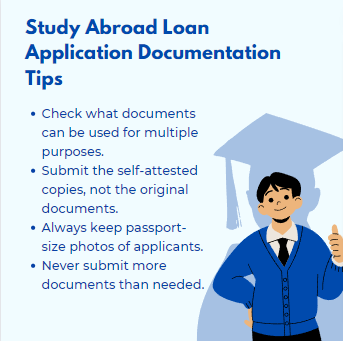
Documents Required for USA Education Loan Application
Having these ready before you approach any lender cuts processing time significantly.
Student documents:
- Valid passport (6 months validity beyond programme end date)
- Class 10, 12, and graduation marksheets and certificates
- GRE / GMAT / TOEFL / IELTS score reports
- University admission letter or offer letter (final, not conditional)
- University fee structure and Cost of Attendance breakdown
- Visa copy (if already received, not mandatory at application stage)
Co-applicant documents:
- PAN Card and Aadhaar Card
- Latest 3 months’ salary slips (salaried) or 2 years’ ITR (self-employed)
- 6 months’ bank statements
- Form 16 or Income Tax Returns (last 2 years)
- CIBIL credit report (above 700 recommended)
Collateral documents (if applicable):
- Property ownership documents (sale deed, property tax receipts)
- Valuation certificate from bank-approved valuer
- Encumbrance certificate
- Property insurance documents
Common Mistakes Indian Students Make With USA Education Loans
Based on patterns I have tracked across hundreds of student loan cases, these are the errors with the most serious consequences.
Starting the loan process after receiving the visa. The visa and the loan sanction letter are interdependent, you need the sanction letter to get the visa, and you need to be ready for disbursement the moment your semester fees are due. Starting late means scrambling at every stage.
- Approaching only one lender. Loan terms vary significantly based on your individual profile. Applying to two lenders simultaneously gives you negotiating leverage and a backup if the first is delayed.
- Ignoring the moratorium interest trap. Interest accrues during the moratorium period, and if not paid, it gets added to principal (interest capitalisation), effectively increasing the total repayment amount. A Rs.50 lakh loan at 11% over a 2-year course plus 6-month moratorium can grow to over Rs.63 lakh by the time your first EMI is due. Know this number before you sign.
- Confusing the sanctioned amount with the disbursed amount. The sanction letter confirms approval. Disbursement happens only after you sign the loan agreement and submit your semester fee demand from the university.
- Not asking about TCS waivers. Tax Collected at Source on international remittances is 5% for education-related transfers above Rs.7 lakh. Many banks offer a TCS waiver or reimbursement benefit when the remittance is routed through the same lending bank, reducing upfront expenses. Always ask your lender explicitly whether they offer this.
- Choosing a lender based solely on the quoted interest rate without reading the processing fee, prepayment penalty clause, and whether interest during moratorium is simple or compounded.
How GradsLoan Helps You Secure an Education Loan for USA Studies
Finding the right lender across dozens of banks and NBFCs takes time most applicants simply do not have. From my experience researching this space, GradsLoan simplifies the entire process by comparing loan options from SBI, HDFC Credila, Avanse, Auxilo, and other leading lenders against your specific profile, university, course, co-applicant income, and collateral availability, in one place.
Their advisors guide you through documentation, sanction letter timelines, and visa financial requirements so nothing catches you off guard at the embassy.
Conclusion
An education loan for USA studies is not a last resort, it is a strategic financial instrument used by over half of all Indian students who study there. The key is choosing the right lender for your specific profile, applying early enough to give disbursement timelines the room they need, and understanding the true total cost of your loan including moratorium interest accrual.
If you have property to offer and are targeting a recognised US university, start with SBI Global Ed-Vantage for the lowest rate. If you need a faster decision or a larger unsecured loan, Credila or Avanse are the right first calls. If neither of those paths is open to you, international lenders offer a genuine solution at a higher cost.
Apply at least 8 weeks before your tuition deadline, prepare your co-applicant’s documents in full before your first bank visit, and request a final sanction letter, not an in-principle letter, before your visa appointment.
FAQs: Education Loan for USA Studies
Which is the best bank for education loan for USA studies in India?
SBI Global Ed-Vantage offers the lowest interest rate (from 10.15%) and the highest trust factor at US embassies. For faster processing or higher collateral-free amounts, HDFC Credila and Avanse are the leading NBFCs. The best lender depends on your specific profile, university, and whether you have collateral to offer.
How much education loan can I get for USA studies?
Indian banks like SBI offer up to Rs.1.5 crore for secured loans. NBFCs like Avanse and HDFC Credila offer up to Rs.1.20 crore without collateral for strong profiles. International lenders like Prodigy Finance and MPOWER offer up to USD 1 lakh (roughly Rs.83 lakh at current rates) without any co-applicant or collateral.
Can I get an education loan for USA studies without collateral?
Yes. SBI offers up to Rs.50 lakh collateral-free for SEVP-certified US universities. HDFC Credila and Avanse offer up to Rs.50 lakh and Rs.1.20 crore respectively without property collateral, based on the student’s academic profile and co-applicant income.
Is a sanction letter enough for my F-1 visa?
A final sanction letter from a recognised Indian bank or NBFC is accepted as financial evidence for the F-1 visa application. It should be accompanied by your co-applicant’s bank statements and your university’s Cost of Attendance breakdown. The consular officer may request additional documents at their discretion.
What is the margin money for USA education loans?
Most Indian lenders require you to contribute 15% of the total Cost of Attendance from your own funds. The bank finances the remaining 85%. Some NBFCs waive or reduce the margin for students admitted to QS top-100 universities or for particularly strong profiles.
How early should I apply for an education loan for USA studies?
Apply the moment your admission is confirmed, ideally 8 to 10 weeks before your first tuition fee payment deadline. For Fall 2026 intake (August start), begin in April or May 2026. Public banks take 15 to 25 working days; NBFCs can be faster at 5 to 10 working days for a complete file.
Does an education loan for USA studies qualify for Section 80E tax benefit?
Yes. The full interest paid on your education loan, regardless of whether the loan is from an Indian bank, NBFC, or approved financial institution, qualifies for deduction under Section 80E of the Income Tax Act. There is no cap on the amount of interest you can claim, and you can claim it for up to 8 consecutive years from the year repayment begins.
What happens to my loan if I do not get a job after completing my US degree?
The moratorium period, typically your course duration plus 6 to 12 months, gives you time to find employment before EMIs begin. If you are unable to secure employment, most lenders allow you to request a moratorium extension. Contact your bank proactively, do not wait for your first missed payment.
Disclaimer: Interest rates, loan limits, and lender policies change frequently. All figures in this article are sourced from official bank portals and verified third-party research as of April 2026. Always verify current rates directly with your lender’s official website or branch before making financial decisions. This article does not constitute financial advice.